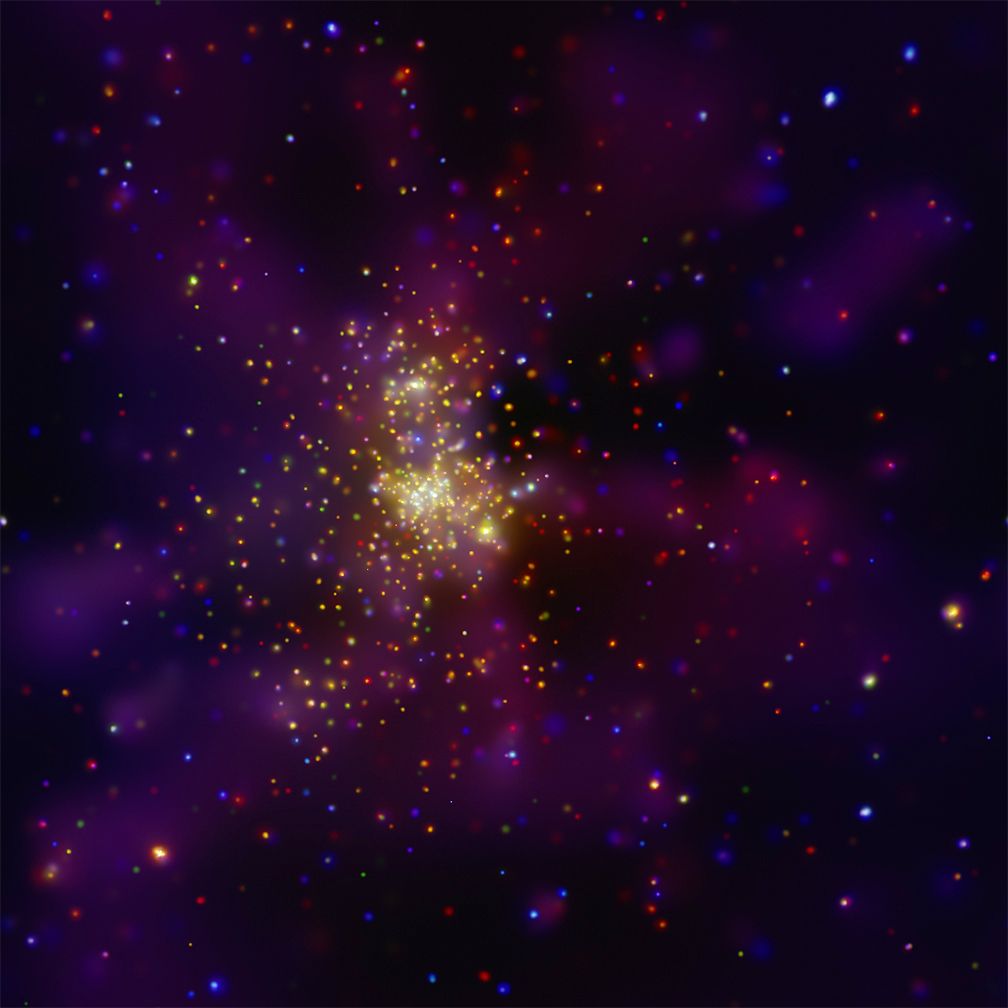
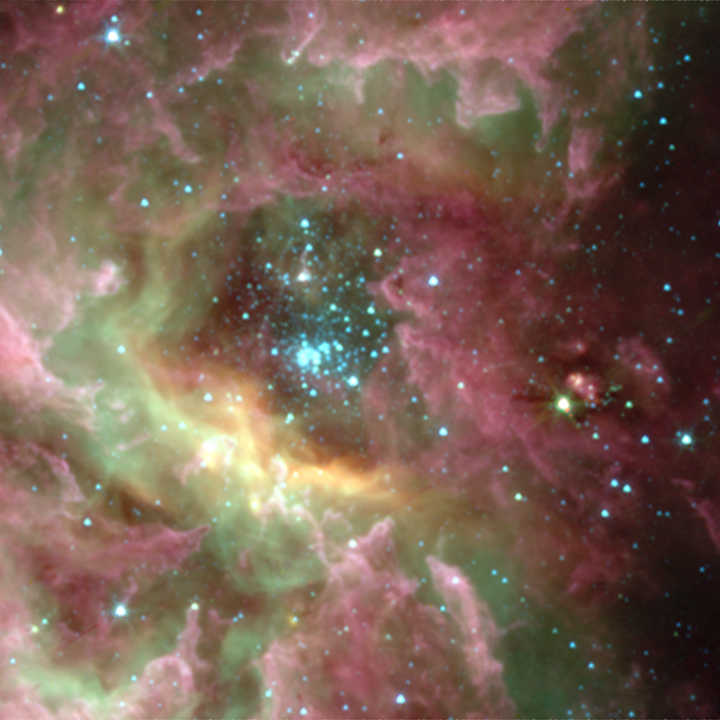
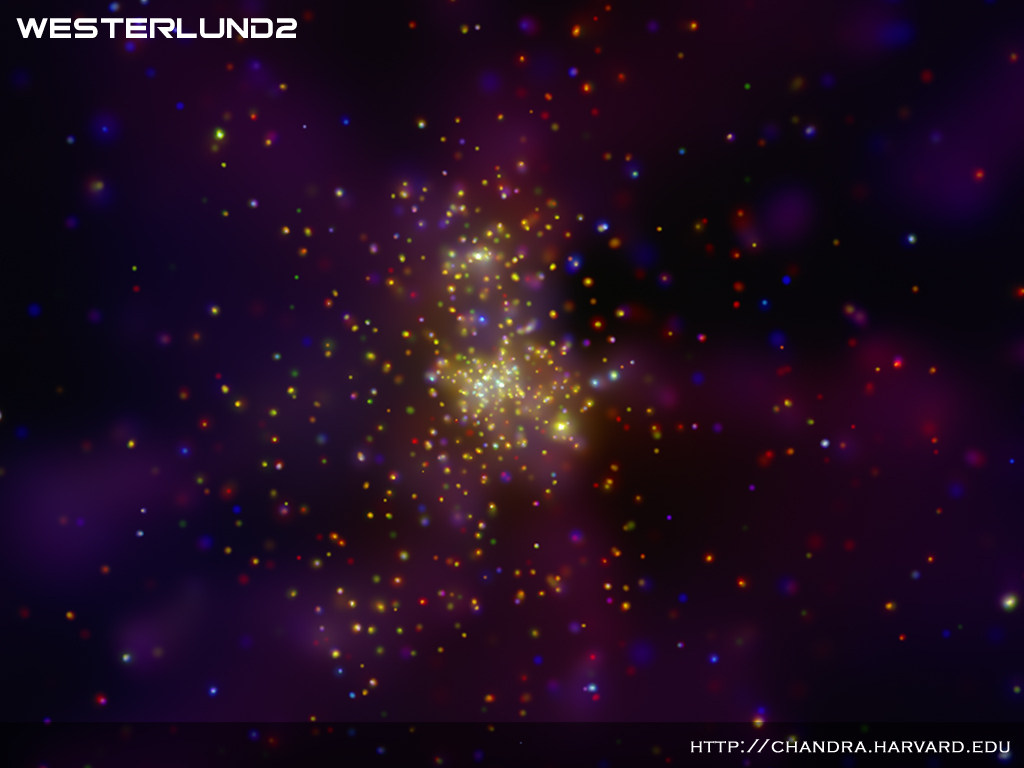
This Chandra X-ray Observatory image shows Westerlund 2, a young star cluster with an estimated age of about one or two million years. Until recently little was known about this cluster because it is heavily obscured by dust and gas. However, using infrared and X-ray observations to overcome this obscuration, Westerlund 2 has become regarded as one of the most interesting star clusters in the Milky Way galaxy. It contains some of the hottest, brightest and most massive stars known.
This Chandra image of Westerlund 2 shows low energy X-rays in red, intermediate energy X-rays in green and high energy X-rays in blue. The image shows a very high density of massive stars that are bright in X-rays, plus diffuse X-ray emission.
An incredibly massive double star system called WR20a is visible as the bright yellow point just below and to the right of the cluster's center. This system contains stars with masses of 82 and 83 times that of the Sun. The dense streams of matter steadily ejected by these two massive stars, called stellar winds, collide with each other and produce copious amounts of X-ray emission. This collision is seen at different angles as the stars orbit around each other every 3.7 days. Several other bright X-ray sources may also show evidence for collisions between winds in massive binary systems.
| Fast Facts for Westerlund 2: |
| Credit |
NASA/CXC/Univ. de Liège/Y. Naze et al
|
| Release Date |
January 23, 2008 |
| Scale |
Image is 8.4 arcmin across. |
| Category |
Normal Stars & Star Clusters |
| Coordinates (J2000) |
RA 10h 23m 58.10s | Dec -57° 45' 49.0" |
| Constellation |
Carina |
| Observation Date |
Three pointings between 08/23/2003 - 09/28/2006
|
| Observation Time |
38 hours |
| Obs. ID |
3501, 6410, 6411
|
| Instrument |
ACIS
|
| Also Known As | Wd 2 | | References | Naze, Y. et al, 2008 A&A, 483, 171; arXiv:0801.0647 |
| Color Code |
Red (0.3-1.0 keV); Green (1.0-2.0 keV); Blue (2.0-10.0 keV)
|
| Distance Estimate |
About 20,000 light years
|
|












Thanks so much for notifying us of this error. We have updated it.
Posted by CXC on Friday, 05.22.15 @ 10:11am
Constellation name of Westerlund 2 may be not Centaurus but Carina.
please confirm it.
Posted by A.NIWA on Sunday, 04.26.15 @ 06:36am